We went to the airport in Munich and came across a unique feature of the airport. It is the first time we have seen this feature. They call them relax areas and they are located throughout areas of the airport.
A relax area in Munich airport
We went and checked out the relax area. There were recliner type chairs in an area with artificial grass and live plants.
Live plants and artificial grass at relax area in Munich airport.
We sat in the loungers waiting for our flight and enjoyed a nice relaxing rest. They also provide free WiFi at the airport allowing us to catch up on emails etc.
Jim, Anne and Shelley relaxing at Munich airport.
There were also cubicles with work stations for people who wanted to do some computer or business work.
Cubicle work stations at Munich airport.
What was very innovative and interesting was the specific area for sleeping. They had designed sleeping quarters called “napcabs” which you could rent for a nap before your flight.
Napcabs in Munich airport
Cost of 30 euros for two-hour napNapcab in Munich airport.
The relax areas are a great feature and reduce stress waiting for your next flight.
We took a trip to Munich, Germany to explore some of the sites. In particular we want to visit Second World War sites and points of interest.
We started our day early flying out of Alicante at 6:30 am. We had a short stop over in Madrid and then off to Munich, Germany. We landed in Munich with no issues.
Ray, Anne, Shelley and Jim at Munich airport
We took the train to get to the centre area of Munich. The train system was easy to figure out and we managed to get the train. We arrived at the central station.
The train from Airport to central Munich
It was an easy walk to our hotel from the central station. We found our hotel with no problems at all. We were impressed by the hotel Uhland, which was very well located in Munich.
The Hotel Uhland in Munich, Germany
After checking in and unpacking, we decided to head out and get something to eat. The hotel clerk recommended a restaurant near the hotel called “Lenz”. We headed out to try the restaurant and have a traditional German meal. It was only a short walk from our hotel to the restaurant, which looked very nice.
German restaurant in Munich with traditional German meals
We found a great spot on the outside patio and settled in for a nice meal.
Shelley, Jim, Anne and Ray at Lenz restaurant
We had a great German meal with a roast pork in a beer gravy with potato dumplings. It was the very delicious and a great way to start out Munich trip.
German meal of roast pork with beer gravy and potato dumplings
We enjoyed the meal and then went back to our hotel to relax before our next adventure.
We took a trip out to Agost, a small town near Alicante. This town is known worldwide for its excellent handcrafted pottery.
We went to a family operated pottery facility which has been in the same family for two hundred years. They provided us with a tour throughout their entire process of making handmade pottery.
We started outside and the guide explained how they select the soil, clean and treat it in preparation to make it into clay.
Guide, explaining the process of selecting the soil for clayFlatbeds for drying the washed soil for clay
We then headed inside the factory to see the next stages of the pottery being created.
The filter process of the soil used for clayThe guide demonstrating the pump system used to get clay
We went into a work area where we watched a potterer create pottery from clay.
A worker making clay pottery and demonstrating the process
We enjoyed the tour and learning about the art of pottery making. We then visited the showroom where there was some very neat handcrafted pottery.
Pottery showroomSome of the finished pottery on display in the showroom
There is definitely an art to making pottery and it was a very interesting process.
We went to Busot, Spain which is a small mountain town 18 kilometers from Alicante. The views were amazing on the way up the mountain on our way to see the Caves of Canelobre.
View from the entrance area of the caves in Busot, Spain
The entrance to the caves is on the northern slopes of the mountain ridge known as Cabezón de Oro.
Entrance to the Caves
We went to buy our tickets to go and see the caves but discovered that they just closed for the day. Our friend Felipe who is also a tourist guide spoke to the manager. He did his magic and the manager opened up the caves just for us. We went down a long hallway to the entrance of the caves.
The hallway to the “Coves del Canelobre”
When we reached the end of the hallway we came to an open cavern area. There was a platform which you could see the large cave area.
Ray in the Caves of CanelobreThe main platform area in the caves
We were able to go to the edge of the platform where we could see all the main areas of the cave. We looked at the main cave area which has a height of 70 meters and is shaped like a cathedral ceiling.
The cave which has many stalactites and stalagmites and is similar in shape as a cathedral ceiling.
It is amazing to see the caves, which were formed millions of years ago. There were different size stalactites and stalagmites throughout the cave. They only grow about 1 cm every one hundred years. Stalagmites are formed by calcium salt deposits formed by dripping water and often unit with stalactites.
Stalactites and stalagmites throughout the cave.
It was neat to be the only ones in the caves and able to see them without any other people around. The main cave area is the candelabra formation, which is the official name of the caves.
Stalagmites formed over many thousands of years.
The caves are a true natural wonder and an amazing site. We enjoyed our visit to the caves and were very thankful to have a private viewing of the caves.
We attended the “Exposicion del Ninot” display where you can vote for the best Fogueres of 2017. What makes this so interesting, is that a miniature of each Foguere of the current year is created. They are put on display for people to view and cast a vote for their favorite one.
Entrance to the Exposicion del Ninot 2017
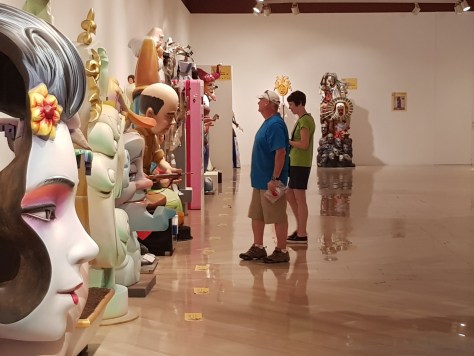
We went inside to view the fogueres and cast our vote. The room was very large and there were fogueres displayed throughout the entire room. Each foguere had an identification card with a number and the barrio it was from.
Foguere identification cardFogueres on display along the entire walls of the large room
We began walking slowly through the room admiring the amazing art of the fogueres. Each one was unique and had great details. Some were whimsical and almost cartoon like.
whimsical foguere
Other fogueres had themes or represented strong messages.
One of the Foguere’s with a specific message.
The message is a quote from Oscar Wilde which states “They’ve promised that dreams can come true, but forgot to mention that nightmares are dreams, too.” The image was very powerful and was very well done.
Foguere with strong message and image
One of the entries commemorates a prominent person involved in the fogueres in Alicante for years.
Foguere commemorating the life of a prominent Spanish person involved in the fogueres for years in AlicanteHomage to Antulio SanJuan Ribes
We walked through the first room amazed at all the great artwork of the fogueres.
Ray looking at the fogueres
After about a half an hour looking at the fogueres we came to another hallway and were shocked to find even more fogueres in the next room.
A second room full of fogueres.Jim and Anne looking at Fogueres
In total there were 89 fogueres which made it very hard to cast our vote. Below is a gallery of the fogueres, try to decide which one of them is the best.


You must be logged in to post a comment.